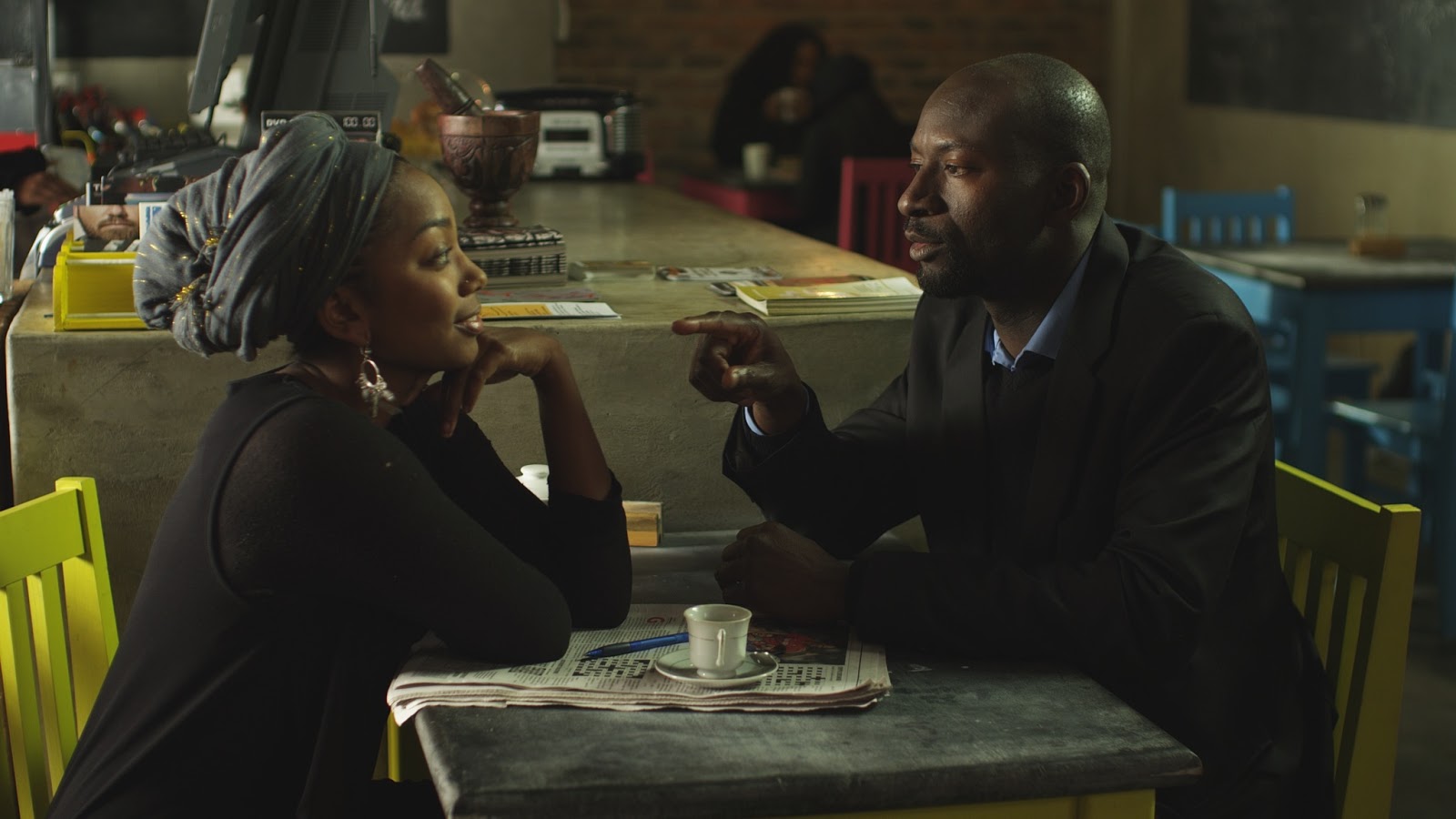
The sound of the match, the exhaling of the smoke from the cigarette or beadie. The fire. The initial inspiration was the fire that took Ernesto’s life that day in 2008. The picture of him set alight haunted and continues to haunt me. Though a picture is silent I could imagine the sound of the flames and that informed the sound design of the film. The heightened unrealistic sound design. The first day I went into the studio, Michael Botha had created a very realistic sound design. I asked him to go more expressionistic. The fire became the recurring motif of the film. In the research material to the film, there was a paper named The Fire that Calls published about service delivery protests. Timothi (Fana Mokoena) evokes the title in a monologue: “That fire out there, is a call for people to listen to us.” In response to the first wave of the violence, the Councillor (Jet Novuka) comes to meet the people at the town hall, proving the statement true, he has literary been called by smoke signals in the sky. The meeting is rowdy and the noisy audience drown the Councillor out , telling him "Now that you’re here, you will listen to us". Fire represents destruction, is also be a representation of passion, energy and ultimately, out of the ashes- something positive can rise. In lieu of recent events this week, we need the energy to fight this new/old plague. Replace destruction with construction.
Sunday, 2 June 2013
The Fire That Calls
Friday, 11 January 2013
The Secret Is In Her Eyes
Buried amidst the haunted corridors of Timothi's (Fana Mokoena) office lies a secret that is at the heart of a disappearance. Timothi's wife Lindiwe (Bubu Mazibuko) carries a secret about a secret, the more she tells us, the less we know. To play the part of the tortured but unobtrusive Lindiwe everything had to be in the eyes of the actress. Bubu Mazibuko is one of the best kept secret's of our industry. Meticulous in her performances, she still makes acting seem deceptively simple. In film, the melody is in the eyes, none better to play that tune than Bubu Mazibuko.
Wednesday, 9 January 2013
The Incredible Mak
All Mak does is turn in great performance after
great performance. Hijack Stories, Yizo-Yizo 3, Stay With Me, he brings a quality to the characters he portrays that can only be described as supernatural. During the research and in the creation of Vusi's character, I read Andile Mngxitama's brilliant essay Blacks Are Kwerekweres/Whites Are Tourists. One paragraph always stayed with me in the construction of the character:
"Truth is many squatter camps which host millions of South Africans are nothing but permanent refuge camps. The multitudes that are trapped there are excluded from our democracy. Their lives are punctuated by violence 24/7. The violence of hunger, denigration, hopelessness and perpetual terror waiting for what the state is going to do next, wondering what dust bowl will follow. The poetry of Abahlali baseMjondolo tells the story of legalised, state-sponsored violence against squatters better. their story is indeed the story of the millions of other squatters."
There is a line in the film where Vusi says, speaking about the government: "these people have betrayed us", I have heard that line, delivered by Mak a hundred times and it still gives me goose bumps. Vusi is a controversial character and Mak was able to bring a humanity to him that has touched and affected audiences the world over.
"Truth is many squatter camps which host millions of South Africans are nothing but permanent refuge camps. The multitudes that are trapped there are excluded from our democracy. Their lives are punctuated by violence 24/7. The violence of hunger, denigration, hopelessness and perpetual terror waiting for what the state is going to do next, wondering what dust bowl will follow. The poetry of Abahlali baseMjondolo tells the story of legalised, state-sponsored violence against squatters better. their story is indeed the story of the millions of other squatters."
There is a line in the film where Vusi says, speaking about the government: "these people have betrayed us", I have heard that line, delivered by Mak a hundred times and it still gives me goose bumps. Vusi is a controversial character and Mak was able to bring a humanity to him that has touched and affected audiences the world over.
Sunday, 6 January 2013
Hakeem kae-Kazim and Fana Mokoena: Actor's Actors
Hakeem kae-Kazim (Ade) and Fana Mokoena (Timothi) first went
head to head in Terry George's Hotel Rwanda and shone again in
Rolie Nikiwe’s Inside Story. In Man On Ground, they illuminate the screen. Both were nominated at the African Movie Academy Awards with Fana taking home the Best Supporting Actor Award. They are what I would
call Actor’s Actors - actors that other actors love to watch.
Thursday, 3 January 2013
Who Took That Picture?
That's a question I've been asked whenever anyone sees The Poster. I never had a concept of what the poster would be. We had
toyed around with a few ideas but nothing concrete. Christopher Grant Harvey, our DIT/Data Wrangler, had been collecting frame grabs from the shoot, and he would send them to me at the end of the day to view. Amongst them was this shot of Femi (Fabian Adeoye Lojede) as he walked through the pigeons. Of all the images, it seemed to capture one of the themes of the film: longing to be free. In that moment as the pigeons fly up past him, Femi is free. Months later, Hakeem kae-Kazim and I stood at the back of
the cinema in Washington watching the film. Man On Ground was the opening night film at The Smithsonian African Art House Film Festival, and when the scene came up on screen, he leaned to me
and whispered: “That should be the poster”. He was right. It was one of those images that the Film Gods had blessed us with.
Wednesday, 2 January 2013
My Cameo In Man On Ground
The cameo was supposed to be a sneak peek at characters from
my next film Tell Me Sweet Something. Lindiwe Matshikiza plays the lead, a young
writer called Moratiwa and I play her publisher. The scene never made it to the
final cut of Man On Ground. You'll hear more from Moratiwa soon.
Thursday, 15 March 2012
The Man Dies
Filmmakers in this country have always had a response to
xenophobia.
I just want to take time to give a shout out.
The Foreigner directed by Zola Maseko
Conversations On A Sunday Afternoon directed by Khalo Matabane
The Burning Man directed by Adze Ugah from the
Filmakers Against Racism Series
A Small Town Called Descent directed by Jahmil XT Qubeka
Africa Shafted directed by Ingrid Martens
Thursday, 16 April 2009
The Man With The Vacant Eyes
Carla Prinsloo, our researcher, conducted a series of
interviews with displaced immigrants. The participants agreed to be interviewed
provided that we never used their images or their real names.
Carla interviewed everyone from an 8 year old Somalian boy who aspired to be a policeman when he grew up to an ex military man who spoke about the inconsistencies between government policy and action. One man’s story stayed with me deeper than the others. It was of a young man who had only been in South Africa for a month (coming to join his father in a spaza shop) when the riots broke out. When his father tried to sneak back to the looted shop to ascertain if there was anything to salvage, his father was shot in the head. He carried a very graphic autopsy photo in his breast pocket.
The picture Carla took of him was haunting. His eyes were bloodshot, but not with rage or resentment. His mouth slightly open. I kept his picture close to me. Carla had captured his bereavement in that one image. His grief was so strong, that from the look in his eyes I knew his father. During the writing process I often returned to this picture of this man: staring into the distance, staring at a future bleak and lonely.
Carla interviewed everyone from an 8 year old Somalian boy who aspired to be a policeman when he grew up to an ex military man who spoke about the inconsistencies between government policy and action. One man’s story stayed with me deeper than the others. It was of a young man who had only been in South Africa for a month (coming to join his father in a spaza shop) when the riots broke out. When his father tried to sneak back to the looted shop to ascertain if there was anything to salvage, his father was shot in the head. He carried a very graphic autopsy photo in his breast pocket.
The picture Carla took of him was haunting. His eyes were bloodshot, but not with rage or resentment. His mouth slightly open. I kept his picture close to me. Carla had captured his bereavement in that one image. His grief was so strong, that from the look in his eyes I knew his father. During the writing process I often returned to this picture of this man: staring into the distance, staring at a future bleak and lonely.
Friday, 6 February 2009
Setswetla - We Will Always Have A Choice
The first step was to let the information osmose. We did not
know at the time what our story would be, but didn’t worry as we knew that The
Research was going to inform the direction we would take.
The process was slow. Fabian and I would meet up anywhere;
at his place or mine, the nearest mall and even a car park and toss ideas around.
Skype allowed us to communicate with Hakeem from his base in L.A. Sometimes we
would plot out a story, only to change it the following day. However, whichever
draft of the story we came up with, the idea of a ‘search’ was always present.
The photographs Alon Skuy took of the riots were arresting.
They spoke of a menace that lurked within the frame and outside the frame. I
wanted the film to have this sense of peril.
The first book I read was Go Home Or Die Here published by
the Wits University Press. One of the chapters in the book by Noor Nieftagodien
entitled “Xenophobia In Alexandra” shaped one of the themes for me. Noor
writes:
“A key moment in the conflict, and perhaps a turning
point, was when a group of attackers marched to Setswetla to launch a raid
against the African foreigners living there. When they arrived at the squatter
camp, the would-be attackers were met with resistance from local
residents…Although this was the most resolute example of resistance against the
xenophobic attacks, there were countless other instances of local organizations
taking very public positions against the violence.”
This had not been widely reported. This got me thinking of
the choices we make as human beings. One set of people can choose to set an
innocent man alight and another set of people will defend the innocent to their
last breath. These choices would be what the characters in Man On Ground would
grapple with.
Sunday, 1 June 2008
Don't You Know If You Help Them, They Won't Go
The tragic events of May left people dazed. Desmond Tutu said
“God, please, please forgive us.” As the nation struggled to come to terms with the
violence that had been unleashed, shelters were set up, communities helped
people that had been displaced, and the questions were flying back and forth: how
could this have happened? It was a time for soul searching. The irony wasn’t
lost on anyone that these attacks had happened in Africa Month. Fabian Adeoye Lojede and the cast and crew of
MNET’s Jacob's Cross met at The Village Walk Mall to donate food and clothing to
the victims of the attacks. A woman saw them and asked Fabian what they were
doing with all the clothes and food. Fabian told her. Without skipping a beat
she replied, “Don’t you know if you help them, they won’t go.” Then she got
into her BMW and drove away.
I had met Fabian through his business partner, director
Mickey Dube. Over the years we had discussed, at various occasions, our visions
of African Cinema, the kinds of films we wanted to make and African politics. He was someone I wanted to
work with. I also wanted to work with Hakeem kae-Kazim, our last collaboration
was God Is African and we had been looking for something to work on. With the
three of us committed to the film we agreed to commission someone to put
together an extensive research package into the riots. Using our own funds we hired a lady that came highly recommended. She promptly got to work.
She returned months later with boxes of books, recordings,
testimonials, comments and analysis. All of us received a pack and we started
the process of going through the research. In the pages of those research documents lay the foundation of the film that would later be called Man On Ground.
Thursday, 22 May 2008
The Burning Man
London
May 2008
It started with this picture of Ernesto Alfabeto Nhamuave.
I was working on my new documentary about Wole Soyinka. The
filming had taken us from South Africa to Nigeria and we had just landed in
London. At my host’s house, I came down for breakfast and the morning paper was
on the table. The unsightly image of a burning man greeted me. More grotesque
were the people around the man, laughing. I picked up the paper to find out
which part of the world this cruelty was being inflicted. I have never
recovered from that picture.
Wednesday, 21 May 2008
Extracts From The Diary Of A Filmmaker
21 May 2008
I remember a moment with a Somali taxi driver in Toronto
last year when I told him I was from South Africa. He asked, “Why are you
killing my people?” I had no answer other than to apologize. There is no 'them' killing his people, it's 'us'. It affects us all and we need to do something and not
ignore the warning signs. I’m not even looking for the rainbow sign because
this is already the fire next time.
Subscribe to:
Posts (Atom)